


Your heavy bench day shouldn't be followed by 72 hours of persistent shoulder clicking and restricted range of motion. You've pushed through the soreness before, but relying on standard NSAIDs to mask rotator cuff inflammation is a losing game for your gut health and long-term performance. It's a common frustration for athletes who refuse to let recovery times dictate their training frequency. You want to stay on the platform without the nagging fear of joint strain or kidney stress.
This guide explores how to leverage high-potency CBD for shoulder pain from lifting to neutralize localized inflammation and accelerate your return to peak intensity. We'll show you how to use 3000mg topicals to clear DOMS faster while maintaining a strict, drug-test-safe protocol. We will examine the clinical precision of NSF Certified for Sport formulas and how they integrate into a professional-tier recovery strategy for 2026. Stop managing the pain and start optimizing the repair process with data-backed recovery tools.
Key Takeaways
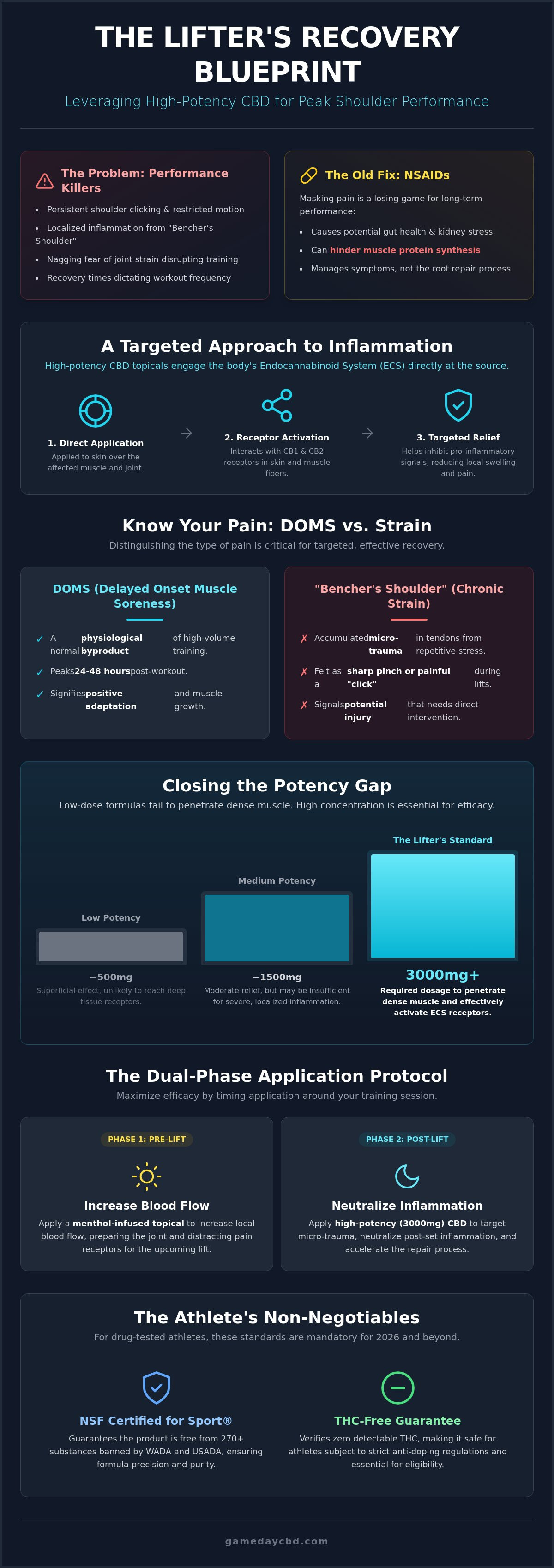
- Identify the "Potency Gap" and why a 3000mg concentration is required to penetrate dense muscle tissue and activate localized ECS receptors.
- Learn how to integrate CBD for shoulder pain from lifting into your recovery stack to bypass the gut and kidney strain caused by chronic NSAID use.
- Master the dual-phase application protocol, using menthol-infused topicals to increase joint blood flow pre-lift and high-potency CBD to neutralize post-set inflammation.
- Discover why NSF Certified for Sport and THC-free status are the non-negotiable standards for athletes adhering to WADA and USADA regulations in 2026.
- Distinguish between standard DOMS and "Bencher’s Shoulder" to apply targeted relief directly to micro-trauma sites in the anterior deltoid and rotator cuff.
Understanding Shoulder Pain from Lifting: DOMS vs. Strain
Heavy pressing demands structural integrity. When you load the bench press or overhead press, your anterior deltoids and rotator cuff tendons bear the brunt of the mechanical tension. Bencher's Shoulder is a frequent result of this repetitive stress. It occurs when micro-trauma accumulates in the anterior deltoid and the long head of the biceps tendon, leading to persistent localized inflammation. This isn't always a structural tear, but it is a performance killer. Using CBD for shoulder pain from lifting allows you to manage this inflammatory response without the systemic side effects of traditional painkillers.
Mechanically, shoulder impingement often surfaces during overhead movements. As you press, the space between the acromion and the rotator cuff tendons narrows. If your technique or volume is aggressive, this narrowing causes friction and heat. You feel it as a sharp pinch or a dull, deep ache. Distinguishing between this mechanical strain and Delayed Onset Muscle Soreness (DOMS) is vital. DOMS is the physiological byproduct of high-volume training, peaking 24 to 48 hours post-workout. While DOMS signifies adaptation, chronic strain signals potential injury. Athletes on a 5-day split can't simply "rest" for a week; they need active recovery protocols that address the specific biology of muscle repair.
Common Lifting Culprits for Shoulder Inflammation
The acromioclavicular (AC) joint takes a beating during heavy horizontal pressing. If your scapular retraction is weak, the humerus shifts forward, irritating the rotator cuff. This often manifests as "the click"—a distinct snapping sound during the eccentric phase of a lift. While a click without pain might be harmless, a painful click indicates the need for targeted intervention. A comprehensive overview of cannabidiol suggests that topicals can assist in managing the localized swelling that causes these mechanical disruptions, helping you maintain joint glide during heavy sessions.
The Role of Inflammation in Muscle Growth and Recovery
Inflammation is a double-edged sword. Acute inflammation is the signal that triggers hypertrophy and tissue repair. You don't want to eliminate it entirely. However, chronic inflammation leads to stiffness and reduced power output. Many lifters fall into the trap of using NSAIDs to get through a session. This is counterproductive. Research indicates that non-steroidal anti-inflammatories can actually hinder muscle protein synthesis. High-potency CBD for shoulder pain from lifting offers a different path. It modulates the inflammatory peak, allowing for faster DOMS clearance without blunting the hypertrophic signals required for growth. By managing the "bad" chronic swelling, you stay on the platform longer and recover with greater precision.
How High-Potency CBD Targets Shoulder Pain
Effective recovery requires precise biological targeting. Your body contains a specialized network known as the Endocannabinoid System (ECS), which features CB1 and CB2 receptors embedded directly in the skin, connective tissues, and muscle fibers. When you apply CBD for shoulder pain from lifting, you're engaging this network to regulate the inflammatory response at the source. This targeted approach is why many athletes prefer topicals over systemic options, as supported by Harvard Health on CBD for joint pain, which notes that creams and lotions can be highly effective for localized issues. By interacting with these receptors, CBD helps inhibit the production of pro-inflammatory cytokines, the signaling proteins responsible for the heat and swelling in a strained rotator cuff.
Clinical efficacy is further enhanced through synergistic ingredients. High-performance formulas often include Menthol and Arnica to create a dual-action effect. Menthol provides an immediate cooling sensation that distracts the pain receptors and increases local blood flow through vasodilation. Arnica works in tandem to address bruising and deeper tissue trauma. This combination doesn't just mask the discomfort; it creates an environment conducive to cellular repair. Integrating a high-potency CBD roll-on into your post-training protocol ensures you're hitting these receptors with clinical precision while the inflammatory cascade is at its peak.
Topical vs. Ingestible: The Athlete’s Choice
Topicals offer a distinct advantage: metabolic bypass. When you consume CBD oils or gummies, the compound must pass through the digestive tract and the liver, significantly reducing its bioavailability. This systemic approach can also lead to unwanted "brain fog" or GI distress during a heavy session. Roll-ons deliver the active ingredients directly to the anterior deltoid or AC joint, bypassing the digestive system for faster action. It's a localized solution for a localized problem. You get the relief where you need it without waiting for your metabolism to catch up.
The 3000mg Standard for Deep Tissue Penetration
The "Potency Gap" is the primary reason most lifters find entry-level CBD products ineffective. A 500mg balm might work for minor skin irritation, but it lacks the concentration gradient needed to penetrate thick athletic muscle mass. To reach the receptors deep within a well-developed shoulder, you need a high-concentration formula that ensures tissue saturation. A 3000mg concentration is the established professional standard for ensuring deep-tissue penetration in high-mass athletes. Without this level of potency, the CBD rarely moves beyond the dermis, leaving the underlying inflammation untouched. High-potency topicals ensure that enough active compound survives the journey through the skin to actually modulate the receptors in the muscle and joint capsule.
CBD vs. Traditional Recovery: Which Protocol Wins?
The standard recovery toolkit is often outdated. Many lifters fall into the Ibuprofen Trap, relying on non-steroidal anti-inflammatory drugs (NSAIDs) to manage persistent joint heat. While effective for short-term numbing, chronic NSAID use is detrimental to an athlete’s gut and kidney health. It can lead to gastric erosion and compromised renal filtration, which are unacceptable risks for those pushing their physical limits. Using CBD for shoulder pain from lifting offers a localized alternative that bypasses these systemic dangers entirely.
Comparing CBD to ice baths reveals a shift from blunt vasoconstriction to precise modulation. Ice baths work by restricting blood flow to the entire limb, which can inadvertently slow the delivery of repair nutrients to the muscle. Cannabinoids work differently. They modulate the inflammatory signals at the receptor level without freezing the joint or halting the natural repair process. When you consider the cost-per-use, high-potency topicals often outperform repeated cycles of lower-tier supplements or over-the-counter medications. A single 3000mg application provides a higher concentration of active compounds than multiple doses of diluted balms, making it a more efficient investment for your recovery stack.
The drug testing dilemma remains a critical concern for competitive athletes. Full Spectrum products, which contain trace amounts of THC, pose a significant risk of a positive test result. In 2026, WADA and USADA standards remain strict regarding THC metabolites. For anyone on the platform, a guaranteed THC-free product is a requirement, not a suggestion. This ensures you receive the anti-inflammatory benefits of the hemp plant without jeopardizing your eligibility or career.
The Safety Standard: NSF Certified for Sport®
For elite lifters, "third-party tested" is a baseline, not a guarantee. The NSF Certified for Sport® designation is the only standard that ensures a product is free from over 280 banned substances. This certification means the formula has undergone rigorous laboratory scrutiny to verify its potency and purity. It eliminates the risk of cross-contamination that often plagues cheaper, non-certified brands. When your reputation is on the line, this level of verification provides the necessary peace of mind to focus entirely on your training.
Managing Shoulder DOMS Faster
Shoulder mobility is non-negotiable for a heavy overhead press. High-volume sessions often lead to muscle guarding, where the body limits range of motion (ROM) to protect an inflamed joint. Targeted application of CBD for shoulder pain from lifting helps restore this ROM by calming the surrounding tissue. Athletes utilizing high-potency topicals report a condensed recovery timeline, often clearing peak DOMS symptoms 12 to 24 hours faster than with rest alone. This allows CBD to act as a bridge between heavy sessions, ensuring you hit your next push day with full mechanical efficiency and zero hesitation.
The Lifting Recovery Protocol: How to Apply CBD for Maximum Efficacy
Precision application transforms recovery from a passive event into an active performance strategy. To extract maximum value from CBD for shoulder pain from lifting, you must synchronize your application with specific training stressors. It's about timing, location, and consistency. You're not just applying a balm; you're administering a high-potency recovery catalyst.
Pre-workout application serves a tactical purpose. Use menthol-infused formulas 15 minutes before your first warm-up set. Menthol acts as a topical vasodilator; it increases local blood flow and provides a thermal sensation that preps the joint capsule for heavy loading. This isn't a substitute for dynamic movement. It's a biological catalyst for it. By warming the tissue externally, you reduce the initial friction on the rotator cuff during those first few sets of pressing.
The post-workout window is equally critical. Apply the roll-on within 30 minutes of your final set to preempt the inflammatory cascade. Using CBD for shoulder pain from lifting during this period allows you to modulate the cytokine response before Bencher's Shoulder stiffness takes hold. Focus on the hot spots: the front deltoid, the posterior capsule, and the insertion of the biceps tendon. These are the high-stress zones where micro-trauma accumulates most rapidly during horizontal and vertical pressing.
CBD also demonstrates a cumulative effect on chronic training strain. Consistent daily use builds a baseline level of cannabinoid activity in the localized ECS receptors. This leads to more predictable recovery outcomes over a 12-week training block. sporadic use yields sporadic results; elite performance requires an elite-tier schedule.
Step-by-Step Shoulder Application Guide
Clean the skin first. Remove sweat and chalk. Ensure the 3000mg formula reaches the dermis without obstruction. Use the roll-on to massage the infraspinatus and supraspinatus. These rotator cuff muscles are often the source of deep-seated impingement. Layer the application for high-intensity sessions. Wait five minutes. Re-apply. Total tissue saturation is the goal.
Complementary Recovery Tips for Lifters
Pair application with dynamic mobility drills. Face pulls and band pull-aparts work best. Move the joint through its full range of motion. Distribute the topical compounds effectively. Prioritize hydration and sleep. Integrating the 3000mg CBD roll on into a nightly recovery ritual ensures repair during the anabolic window. Optimize your recovery stack by securing the 3000 MG CBD Roll-on For Muscle & Joints today.
The Gameday Edge: Why 3000mg CBD is the Lifter’s Standard
Elite performance demands concentrated solutions. Gameday CBD focuses exclusively on high-potency topicals because professional-tier muscle mass requires a higher concentration of active compounds to trigger a response. While standard retail balms offer low dosages that barely penetrate the dermis, a 3000mg concentration ensures that CBD for shoulder pain from lifting actually reaches the localized receptors in the joint capsule. This is clinical precision. No fillers. No fluff. Just a potent dose of active CBD designed to handle the inflammatory load of heavy resistance training. It's an equipment recommendation for your recovery stack, not a lifestyle suggestion.
The roll-on applicator is a tactical requirement for the gym environment. Lifters don't have time for messy creams that compromise their grip or leave greasy residue on the barbell. The roll-on allows for targeted, mess-free application directly to the anterior deltoid or rotator cuff between sets or immediately post-workout. For those following high-frequency training programs, the 3000mg CBD Roll-On Victory Bundle provides the necessary volume to sustain a consistent daily protocol. It ensures you never miss a session due to avoidable joint heat or lingering soreness. You maintain the grit of your training cycle while utilizing the sterile precision of modern recovery science.
Engineered for Professional Standards
The Zero THC guarantee is the cornerstone of the Gameday formula. Protecting athletes from accidental positive drug tests is a non-negotiable priority. Every batch is verified to meet WADA and USADA standards, providing the security needed for competitive platforms. Professional trainers recommend this specific protocol for shoulder and joint recovery because it combines immediate physiological feedback with long-term repair. The formula utilizes Menthol for immediate cooling and vasodilation, followed by a heavy dose of CBD to address the underlying inflammatory peak. It's a technical advantage that standard wellness products don't provide.
Fueling Your Next PR
Faster recovery is the direct path to increased training frequency. When you clear inflammation efficiently, you can return to heavy pressing sooner, leading to greater total volume and better hypertrophic gains. Choosing the right CBD for shoulder pain from lifting requires a strict checklist: NSF Certified for Sport status, a minimum 3000mg concentration, and a 100% THC-free lab report. Don't settle for under-dosed alternatives when your performance is on the line. Secure your recovery and Shop the 3000mg CBD Roll-On for Muscle & Joints to ensure your next PR isn't sidelined by shoulder strain.
Future-Proof Your Shoulder Recovery for the Next Platform Session
Maintaining a high-frequency training split requires more than just grit. It requires a recovery protocol that matches your intensity. You now understand that standard, low-dose topicals fail to reach the deep receptors in well-developed muscle. True efficacy comes from a 3000mg High-Potency Formula that ensures tissue saturation and modulates the inflammatory peak. By choosing NSF Certified for Sport® products, you eliminate the risk of contaminants while managing CBD for shoulder pain from lifting with clinical precision.
Elite lifters trust these standards because they can't afford a setback. Every application is a tactical move toward your next personal record. Don't let localized inflammation dictate your volume or force you into the Ibuprofen Trap. It's time to upgrade your recovery stack with the same discipline you bring to the barbell. This protocol is trusted by professional athletes who require safety and results in every session.
Secure Your Recovery: Shop the 3000mg CBD Roll-On
Your progress depends on your ability to return to the gym without restriction. Stay resilient, stay vetted, and keep pushing the standard.
Frequently Asked Questions
Is CBD for shoulder pain from lifting legal in competitive sports?
Yes, CBD is permitted under WADA and USADA regulations for 2026. While CBD is legal, all other cannabinoids remain prohibited. Competitive athletes must use a verified THC-free isolate to avoid testing violations. Verify the NSF Certified for Sport status to ensure your recovery tools meet professional regulatory standards and contain no banned substances.
How much 3000mg CBD roll-on should I use for a shoulder strain?
Apply a single, thorough layer across the entire joint and surrounding muscle tissue. For a significant strain, cover the anterior deltoid and the posterior capsule completely. A 3000mg concentration provides a high density of active compounds, so a thin, even coat is sufficient for deep tissue saturation. Re-apply every 4 to 6 hours as needed to maintain localized receptor activation throughout your recovery window.
Will using a CBD topical cause me to fail a drug test?
No, provided the product is a 100% THC-free isolate. Topicals deliver compounds to the localized ECS receptors in the skin and muscle rather than entering the bloodstream in significant quantities. Using CBD for shoulder pain from lifting that is NSF Certified for Sport guarantees the absence of THC and other banned substances. This provides the clinical certainty required to pass rigorous athletic drug screenings without hesitation.
How long does it take for a high-potency CBD roll-on to start working?
You'll feel the cooling effects of the menthol within 60 seconds. The deeper biological modulation of the CBD typically takes 15 to 30 minutes to reach the localized receptors. This high-potency formula is engineered for rapid absorption, bypassing the metabolic delays associated with ingestible products. Consistent application leads to more predictable and faster recovery windows as the compounds accumulate in the targeted tissues.
Can I use CBD roll-on before I start my lifting session?
Yes, applying the roll-on 15 minutes before your first set can optimize joint preparation. The menthol increases local blood flow through vasodilation, acting as a technical warm-up for the rotator cuff and anterior deltoid. Using CBD for shoulder pain from lifting pre-workout helps manage the heat and friction of heavy pressing. It allows you to maintain full mechanical intensity during your session without premature stiffness.
What is the difference between Gameday's 3000mg roll-on and standard drug store CBD?
The primary difference is the "Potency Gap" and the certification standard. Drugstore products often contain 500mg or less, which is insufficient for penetrating dense athletic muscle mass. Gameday’s 3000mg formula provides the concentration gradient needed for deep tissue saturation. Standard retail products also lack the NSF Certified for Sport designation. This leaves competitive athletes vulnerable to cross-contamination and prohibited substances that could jeopardize their careers.
Is CBD better than ibuprofen for lifting-related inflammation?
CBD offers a targeted, non-systemic alternative that avoids the common pitfalls of chronic NSAID use. Ibuprofen can lead to gastric erosion and kidney strain; it may also blunt the hypertrophic signals needed for muscle growth. CBD modulates the inflammatory response at the receptor level without these metabolic risks. It allows you to manage localized heat while preserving the natural repair processes required for long-term strength gains.
Can I use CBD for rotator cuff tears or just for muscle soreness?
CBD is effective for managing the inflammation associated with both tears and soreness, but it isn't a structural cure. While it can neutralize the localized heat and swelling of a rotator cuff injury, structural damage requires a professional clinical assessment. Use the roll-on to manage the symptoms and maintain range of motion while you follow a prescribed rehabilitation or strengthening program to repair the underlying tissue.